
Blog · Goalie how-to
Goalie skating: the five moves every goalie needs
Goalie skating is its own thing. A forward skates to go fast. A goalie skates to arrive somewhere set: square to the puck, balanced, stick on the ice, ready to make the save. If you get there a half-second late, or get there off balance, the best glove hand in the world doesn't help.
That's why "power skating" for goalies looks different. Fewer long strides, more short, sharp pushes that start and stop in the stance. Here are the five moves every goalie needs, in the order we teach them.
1. The shuffle
What it's for: small moves across the crease, when the puck moves a little and you need to stay square.
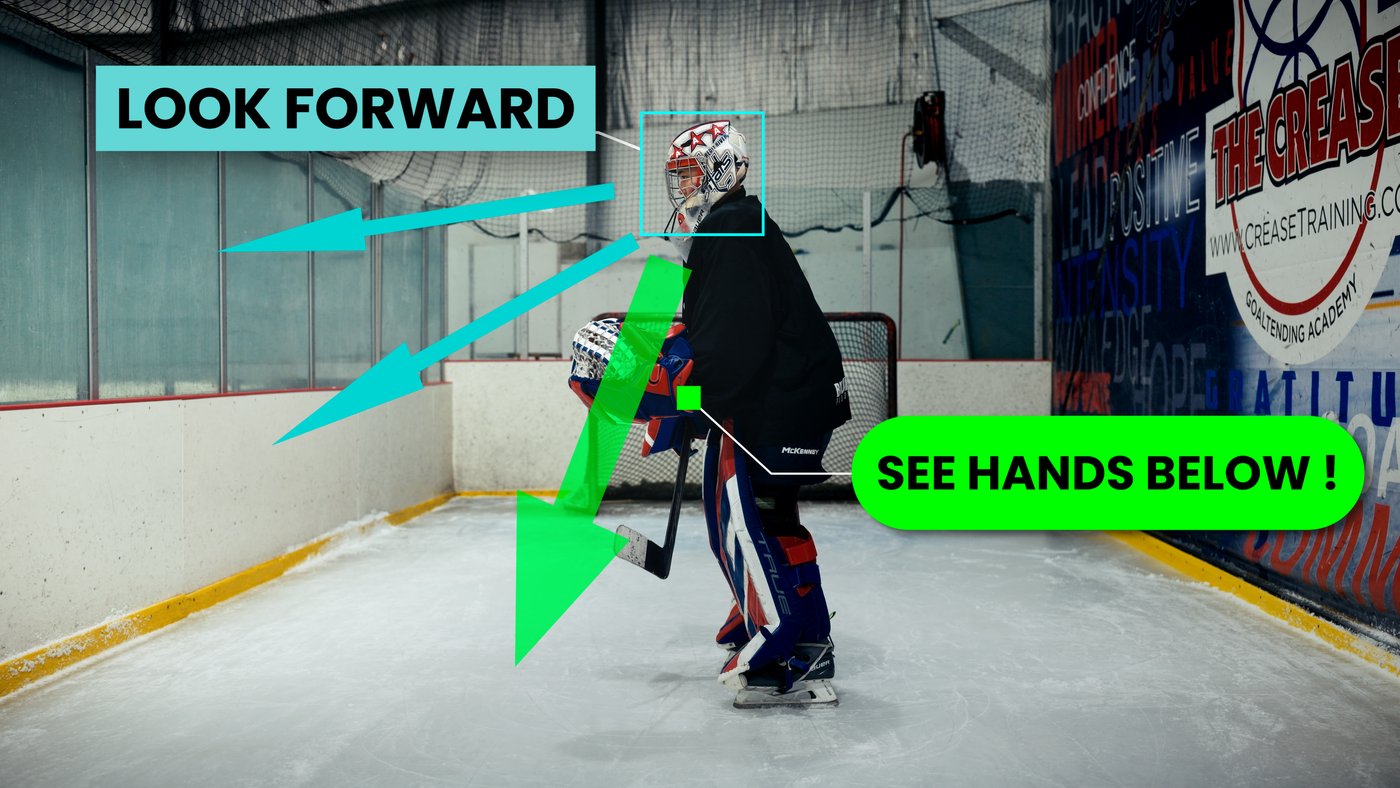
Stay in your stance. Push off the inside edge of one skate and let the other skate slide along the ice, then bring the push skate back under you. Your pads stay facing the puck the whole time. Your head and hands don't bob.
Fix this first: standing up. If your shoulders rise when you shuffle, your knees have straightened. Keep the same knee bend from start to finish.
2. The T-push
What it's for: bigger moves, like a pass across, or getting post to the top of the crease.
Turn your lead skate toward where you're going, so your skates make a T. Push hard off the back skate's inside edge, glide on the lead skate, and stop by turning back square with a short, sharp edge. Then you're back in your stance.
Fix this first: turning your shoulders with your skate. Only the lead foot turns. Your chest and pads stay on the puck as long as they can, and you look where you're going before you go.
3. The C-cut
What it's for: moving out to challenge a shooter, and backing in as the play comes toward you.
From your stance, push with one skate in a "C" shape under your body while the other glides, then switch. Backward C-cuts let you retreat with the play while staying square; forward ones let you step out to cut down the angle.
Fix this first: big, slow C's. Short C's keep you in control and keep your stance. You're adjusting depth, not skating laps.
4. Pivots
What it's for: turning with the play when the puck goes behind the net or to the corner.
Rotate on the balls of your feet and open your hips toward the new angle, keeping your stance. The goal is to face the puck again in one move, not three small ones.
Fix this first: looking late. Your eyes lead and your body follows. Find the puck, then turn.
5. Recoveries
What it's for: getting back up, or back across, after you've gone down.
From the butterfly, look at the puck, bring the far leg up and push off it to get back to your feet or slide across on your pads. A good recovery means a rebound becomes a second save instead of a goal.
Fix this first: getting up with both legs at once. Lead with the leg on the side you're going to, and keep your hands in front.
How to practise goalie skating
- Warm up with it, every time. A few lengths of the crease each way: shuffles, then T-pushes, then C-cuts in and out.
- Post to post. T-push from one post to the top of the crease, stop square, shuffle to centre, T-push back to the other post.
- Make it game-like. Have a shooter or coach point where the puck is going; move on the point, not on a count.
- Slow first, then fast. Get each move clean at half speed. Speed without the stance just makes mistakes faster.
Where to learn it
Every move here has its own lesson in the Crease Goaltending Rookie Series: 02 Shuffle & T-push and 03 C-cuts & Pivots, with Coach Dave Dolecki and Coach Nate Colitto. See the Rookie Series
Or work on it on the ice: goalie skating is one of our coaching lessons in Toronto and the GTA, at Canlan Ice Sports Etobicoke, the Cwench Centre and nearby rinks. Goalie coaching
Learn it
With the series, or on the ice
More from the blog
Goalie how-tos and NHL goalie news
NHL goalies
Reimer pulled in his Rangers debut: what a goalie does after a bad period
James Reimer gave up 3 goals on 8 shots and was pulled after one period in his Rangers debut. What happened, and how a young goalie should handle getting pulled.
NHL goalies
Goalie week: Hellebuyck lands in New Jersey, Fowler shines outdoors
NHL goalie news from Oct 19-26: Hellebuyck goes to the Devils, Reimer signs with the Rangers, Fowler stops 33 outdoors. Plus what young goalies can take from each.
Goalie how-to
Goalie pad size chart: how to size goalie pads
Goalie pad size chart by floor-to-knee and ankle-to-knee, what the +1 means, and the fit checks a goalie coach makes in the butterfly. Youth to senior.